Importance of Major European Waterways
Major European waterways have played a crucial role in trade and economic activity across the continent for centuries. That remains true today. Inland waterways are still widely relied on for the transportation of a range of goods and commodities; food and agricultural products are no exception. As per the CCNR (Central Commission for the Navigation of the Rhine) 473.3 million tonnes of goods were transported via EU’s waterways in 2024, the river Rhine in Germany being responsible for the majority (284.5m tonnes) of which nearly 20% were either food or agriculture-related goods. With record heatwaves and accompanying drought across most of Europe this summer the continent’s waterways are already showing signs of stress and with average summer temperature records being consistently broken, the EUs waterways could become less and less reliable in the coming years.
The Rhine Under Pressure
The Rhine best illustrates the strain now affecting Europe’s inland waterways. In 2026, historically low water levels along parts of the river have begun to disrupt logistics, reducing freight capacity and driving up transport costs. Katherina Stelzer, an executive at RWZ, told Reuters that the company’s Rhine shipments had dropped sharply compared with normal July–August volumes, with only around 10% of its usual freight moving by river. The resulting loss of waterborne capacity has led CMA CGM to apply an “inland emergency fee” of €50 per container reportedly to cover extended docking times, adding further inflationary pressure to logistics costs that may ultimately be passed on to consumers. The Rhine’s shrinking freight transport capacity and longer docking times are driving more freight to less efficient, more expensive land-based transport methods.
What Impact Will This Have?
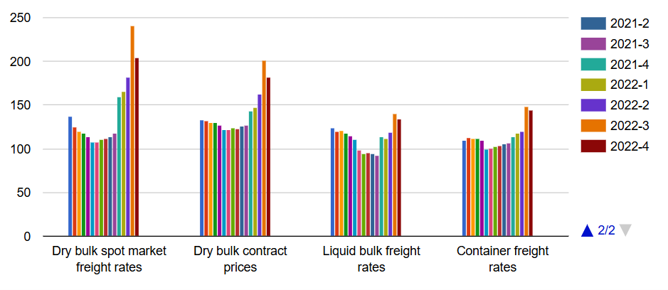
As always, it is almost impossible to predict where and how hard this impact will hit, however, historical evidence suggests that pricing pressure may continue to build until water levels return to normal. A report from the CCNR highlighted the implicitly causal relationship between low water levels and freight rates (waterborne logistical base cost) as shown below. The graph demonstrates a clear rise in the average freight rates observed during 2022 especially the latter half of 2022 (+42.5%) when compared to 2021. While 2026 still lacks a complete data set it is likely to produce similar if not even more extreme deviation in freight rate costs compared to the statistical average.
Beyond the Rhine
Whilst the Rhine provides the most widely cited evidence, it is not the only major waterway to see decreased traffic due to declining water levels. The Danube is another vital waterway utilised to transport a wide array of goods and has seen similar levels of impact in the last decade with 2018 and 2022 both considerably affected just as we are seeing now in 2026. Whilst goods travelling via the Danube are less heavily represented in western European markets, they still provide a useful indicator as to the increasing severity of supply chain pressures posed by declining water levels in these key inland waterways, especially in reference to grains given the regions outsized production of such goods.
Level of Impact
As always, it is almost impossible to accurately estimate as to the level of impact the current low water levels will have on food goods pricing across Europe and especially in the UK as there are simply too many factors to quantify. However, several reports most notably a 2024 paper published in Nature Food suggested that transportation can account for somewhere in the region of 25-36% of the landed cost of agricultural goods with grains being the most affected due to their low weight-to-value ratio. If we combine this with data from an annual report from the CCNR citing freight rates for agribulk goods rose by 2.5 times at the height of low water levels in 2018 we can quickly envision sharp pricing pressure affecting all grain-based food goods in the coming months.
Poor European harvests will only compound these cost pressures, accentuating the impacts already seen across the category. With average spring and summer temperature records being broken year on year across Europe this elevated cost in inland shipping could be here to stay, helping to set a new baseline cost on imported European grains, seeds and oils for the coming decade.
With multiple cost pressures already facing hospitality operators, procurement teams need to be increasingly proactive and agile when designing menu offerings and sourcing strategies in order to protect margins.